Naked City
The Case For a Green Lagos
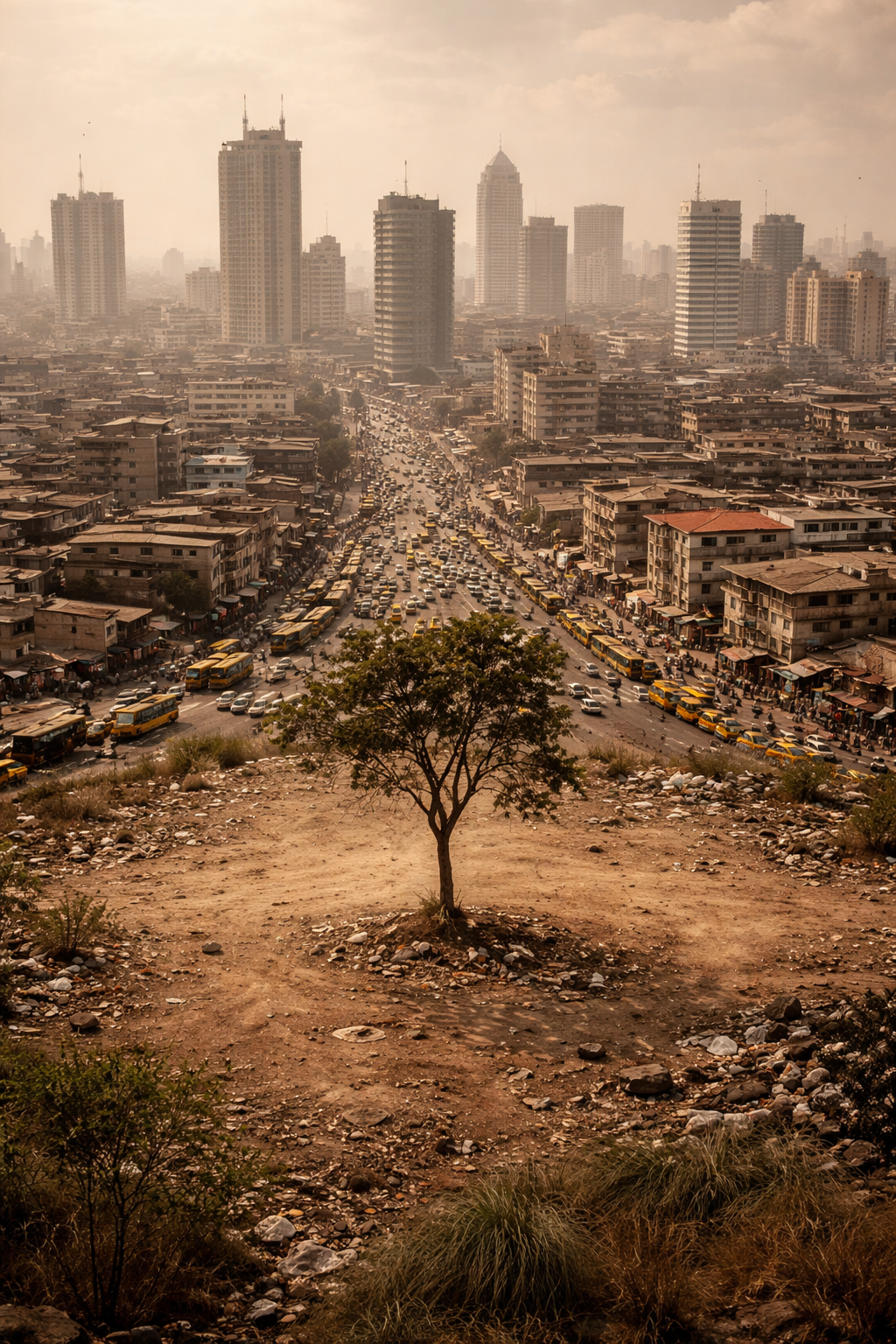
There is a particular kind of heat in Lagos that settles in after the rains. The air becomes heavy and still, the sun bears down on asphalt, concrete, zinc roofs and exposed sand, and the city offers very little relief. In many neighbourhoods you can walk long distances without encountering a tree. Bus stops, markets, schools and motor parks sit fully exposed. Shade is scarce, and where it exists, it is accidental rather than planned. Lagos is a naked city.
This nakedness is not incidental. It is the outcome of how development has been imagined and executed over time. Roads are widened, land is reclaimed, housing estates are built, but greening is rarely treated as part of the core urban project. Trees are cut down and not replaced. Mangroves are cleared for housing and infrastructure. Public parks are few, unevenly distributed and poorly maintained. What this produces is not just a visually harsh city, but one that is economically less efficient and socially more unequal than it needs to be.
Heat, work and the everyday economy
Most Lagosians do not work in climate controlled offices. They work outdoors or in poorly ventilated spaces. Street traders, transport workers, artisans, market women, security guards and construction labourers make up a large share of the city’s labour force. For these workers, heat has direct economic consequences. It affects how long they can stay on their feet, how fast they move, how much they can carry, and how many hours they can realistically work in a day. When temperatures rise, productivity falls, particularly in physically demanding and informal jobs.
Urban trees and green cover reduce ambient temperatures through shade and evapotranspiration. Even modest increases in tree density can lower neighbourhood temperatures by several degrees. In a tropical city, that difference is significant. It can mean fewer rest breaks, less exhaustion, and longer effective working hours. Scaled across a city of more than twenty million people, these marginal effects accumulate into meaningful losses or gains in output. The absence of shade functions as a quiet drag on the everyday economy.
The burden of this drag is uneven. Wealthier households can retreat indoors, run generators and install air conditioning. Poorer households cannot. Heat exposure is therefore regressive, both in its health effects and in its impact on income. Greening, by contrast, is one of the few urban interventions that directly benefits those who are most exposed. A tree-lined street helps everyone who passes through it, regardless of income.
Health costs and public expenditure
Heat also shows up in health outcomes. Prolonged exposure increases the risk of dehydration, cardiovascular stress and respiratory problems. It worsens existing conditions and contributes to fatigue and stress. For low income households, illness has immediate financial consequences. Medical expenses compete with food and rent, while days lost to sickness reduce income directly. These private costs spill over into public health systems through higher demand for clinics and hospitals, especially during extreme heat periods.
Seen from this angle, green spaces operate as preventive health infrastructure. Trees, parks and shaded streets reduce heat stress, improve air quality and create spaces for rest and recovery. In cities with constrained health budgets, prevention is typically far more cost effective than treatment. Yet in Lagos, health considerations rarely feature in land use decisions or infrastructure planning. Green space is treated as optional, rather than as part of the city’s basic health and productivity apparatus.
Land, value and spatial inequality
Land markets add another layer to the problem. A common argument against parks and open space is that land in Lagos is too scarce and valuable to leave unbuilt. This argument makes sense from a narrow private perspective, but it ignores wider social effects. Well designed green spaces tend to increase surrounding land and property values, making neighbourhoods more productive and desirable. In settings with effective property taxation, some of this uplift can be captured and reinvested. In Lagos, most of it is privatised.
As a result, green amenities are disproportionately concentrated in elite areas. Gated estates, waterfront developments and low density neighbourhoods are more likely to have trees, gardens and setbacks. Dense, low income areas are left with concrete and heat. This spatial pattern reinforces inequality, even though the economic returns to greening are often higher in poorer neighbourhoods where heat exposure is greatest and baseline amenities are lowest.
Mangroves and the illusion of empty land
The treatment of mangroves around Lagos illustrates the same logic at a larger scale. Mangroves are routinely framed as empty or underutilised land, suitable for reclamation and conversion. In reality, they provide valuable services. They reduce flooding and erosion, buffer storm surges, support fisheries and store carbon. Replacing these functions with engineered infrastructure is expensive and often imperfect.
When mangroves are cleared, the financial benefits are immediate and concentrated. Land is sold, investment flows in, projects are commissioned. The costs arrive later and are widely shared, through increased flooding, infrastructure damage and loss of livelihoods. With weak regulation, high discounting and pervasive corruption, decisions predictably favour short term gains over long term resilience. What looks like development in the present becomes vulnerability in the future.
Why the market will not fix this
It is tempting to believe that these issues will resolve themselves as the city grows richer. Experience suggests otherwise. Markets tend to underprovide public goods like green space, especially where benefits are diffuse and long term, and costs are immediate and localised. In Lagos, infrastructure provision is shaped by patronage and rent seeking. Projects that generate visible outputs and financial flows are prioritised. Trees do not fit neatly into this model. They require maintenance, offer no obvious rents, and produce benefits that are hard to attribute to any single actor.
This means that the absence of greening is not simply a planning oversight. It reflects deeper political and institutional incentives. Any serious proposal for a greener city has to contend with these realities rather than ignore them.
What can be done within real constraints
Grand master plans are unlikely to be effective in this context. More incremental approaches stand a better chance. One option is to embed greening directly into existing infrastructure spending. Roads, transport corridors and market upgrades can include mandatory tree planting and shade provision as part of their design, rather than as add-ons. This ties green investment to budgets that already exist.
Another priority is to focus explicitly on high density, low income areas. Street trees, shaded markets, small neighbourhood parks and schoolyard greening offer high returns relative to their cost. Community involvement can help with maintenance and local ownership, though it should complement, not replace, public responsibility.
Mangrove protection requires clear no-build zoning backed by public scrutiny. Even in weak institutional settings, legal designation and visibility matter. Framing mangroves as climate adaptation and flood control infrastructure, rather than as abstract environmental assets, can broaden political support.
Finally, small, enforceable rules may be more effective than ambitious visions. Minimum shade requirements in public markets, green buffers along waterways, and tree replacement mandates for new developments are all modest interventions, but they are harder to ignore and easier to monitor.
A green city as an inclusive project
A green Lagos should not be imagined as a city of manicured lawns or exclusive parks. It should be imagined as a city where walking is less punishing, where markets offer relief from the sun, where children can play without baking on concrete, and where flooding is less destructive. The economic logic aligns closely with concerns about equity and liveability. Those who suffer most from heat and environmental degradation are those least able to shield themselves from it.
Lagos will continue to grow. The question is whether it continues to grow in a way that strips away shade and natural protection, or whether it begins to treat trees, parks and mangroves as part of its productive base. The costs of the current path are already visible. The benefits of an alternative are not hypothetical. They are simply underprovided.